Hidden costs of fragmented HR systems: When to consolidate
Fragmented HR systems create hidden costs over time through manual work and increasing integration complexity. Learn how to spot the signs you’ve outgrown a patchwork HR tech stack and the practical steps for consolidating to a single HCM platform.


Table of Contents
A payroll system here, a recruiting tool there, and eventually everyday tasks require logging into multiple applications and manually moving data around between systems. This isn’t optimal, but it’s not uncommon, either.
The result of this disconnect is more manual work that steadily drains time and budget. It can also lead to slower decision-making and growing frustration among staff and administrators.
Once you know where the hidden costs are, the best practices for consolidating HR systems into HCM will become a lot clearer.
Key takeaways
- HR systems often get fragmented over time as new tools are added to solve specific problems.
- When these systems don’t effectively share data, manual work tends to increase while confidence in reporting decreases.
- Hidden costs tend to show up as operational drag that teams learn to gradually accept as normal.
- Organizations often recognize they’ve outgrown patchwork systems when payroll cycles slow or reporting requires a lot of manual cleanup. You might also notice integrations beginning to break.
- Consolidating HR tools into a single HCM platform can help create a more stable foundation for workforce data.
Challenges of multiple HR systems
System fragmentation within your human resources department may not be obvious at first glance. Each HR system may be working just fine on its own.But what happens when information from one system is needed in another tool? Does this data automatically transfer, or does someone have to copy it over manually? That’s where problems often begin.
Employee records might live in one application, payroll in another, and workforce scheduling in a different tool. And that can result in a constant need to reconcile records and confirm which version of data is correct.
Unfortunately, HR teams regularly deal with these issues.
A 2025 survey by HR.com found that nearly 80% of organizations use between two and seven paid HR solutions from different vendors, while fewer than 40% said those tools integrate well or extremely well.
The hidden cost of HR software lies in these gaps. HR teams spend time validating data, finance leaders question reporting accuracy, and IT teams continually patch systems that weren't designed to work together.
Fragmentation can also limit how effectively organizations adopt AI. AI-powered tools depend on clean, connected, and trustworthy workforce data to surface useful insights, automate routine work, and support faster decision-making. When data is scattered across systems or must be manually reconciled, teams may struggle to get dependable outputs from AI-enabled capabilities.
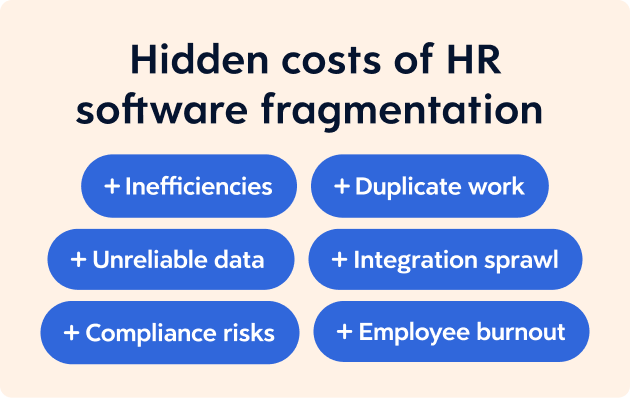
Hidden costs of HR software fragmentation
The operational friction created by fragmented systems often comes to light in measurable ways. Continuous reconciliation work, reporting delays, compliance exposure, and the growing need for IT patches all carry real-world costs.As they often develop gradually, it’s easy to overlook these issues. But left unchecked, they build until they become undeniable. Let’s take a closer look at where the effects tend to show up and grow over time.
Inefficiencies and duplicate work
When employee data lives across different platforms, you run the risk of manual reconciliation becoming routine. And that has a price.It takes valuable time for HR staff to enter information multiple times or check records across systems to confirm accuracy. When data doesn’t sync as expected, payroll teams often end up reviewing reports manually before processing. That can slow pay cycles and make errors more likely.
Payroll and wage errors can carry real financial consequences. In fiscal year 2025, the U.S. Department of Labor recovered more than $259 million in back wages for nearly 176,957 employees.
Compliance risk
Compliance challenges can grow when policy rules and employee records sit in separate systems. Benefits eligibility, for example, might be applied inconsistently if data doesn’t automatically update across platforms.It can also prove problematic if payroll adjustments rely on outdated information. Even small discrepancies can compound across pay cycles or reporting periods, until they draw regulatory scrutiny.
Organizations pay for compliance and regulatory issues through fines and penalties that can range from hundreds to thousands of dollars per instance.
Decision delay
Good decisions need reliable data, and fragmented systems can make that harder to come by. When workforce data must be manually pulled and consolidated from multiple reports before leaders can act, speed and confidence can suffer.Patchwork environments can also encourage “shadow tech,” where teams turn to spreadsheets or other workarounds because official systems feel difficult to use or unreliable. These unofficial processes may solve an immediate problem, but they can create new risks when critical workforce data sits outside governed systems.
Findings from HR.com’s survey showed that well under half of respondents said their HR technology produces analytics that are actionable (33%) and accurate (42%). Most blamed poor system integration, with 81% saying it limited their ability to meet HR goals.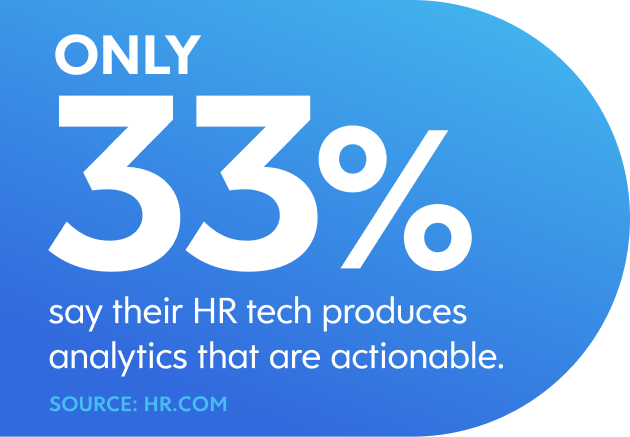
Integration sprawl
Each HR system added to the stack can create new work for an organization’s IT department. That can include monitoring data transfers or applying vendor updates. It might also mean investigating data sync issues and patching vulnerabilities. And the team does it all as new tools and user expectations are introduced.Over time, small workarounds become what can feel like a house of cards, a fragile network of connections that requires constant protection and oversight. Maintaining that network can start taking up significant time and money.
Burnout and turnover
Behind all HR solutions are the people who work within the platforms, and fragmentation can take a toll on these valuable workers.When integrations fail, HR teams often handle the manual fixes and data reconciliation. This repetitive administrative work can pull them from the strategic initiatives that attracted them to the field in the first place. This can lead to burnout and higher turnover rates.
One recent study found that 56% of employees required to perform repetitive data tasks experience burnout, leading to lower productivity and a higher risk of turnover. And nearly one-third of HR professionals say they’re working beyond capacity and are actively job hunting.
When you’ve outgrown patchwork solutions
At some point, the signs get hard to ignore. Manual tasks and data reconciliation pile up. Payroll cycles drag. Reporting turns convoluted and unreliable. New workforce practices introduce compliance questions that existing tools were never designed to handle.Morale can also slip when employees and managers are left to navigate multiple platforms to complete basic tasks. In Dayforce research, 69% of workers said their organization has too many technology platforms, a common source of day-to-day friction.
Signals like these suggest your organization may have reached the limits of its patchwork approach. An end-to-end HCM platform with a single data model can give leadership a more stable foundation, one built to handle growth and operational complexity.
Best practices for consolidating HR systems into HCM
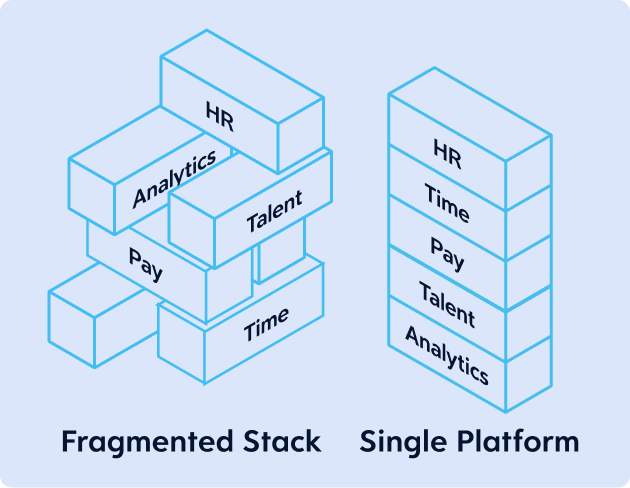
Consolidating HR systems takes careful planning, especially when tools have accumulated through the years. Yet your objective isn’t just to replace software. Your goal is to create a cleaner operating model where all workforce data flows through a single source of truth. These best practices can help you get there.1. Take inventory of your current HR technology
Start by mapping the systems you currently use for HR, payroll, time tracking, recruiting, training, and workforce engagement. Document which teams rely on each platform and where data needs to flow between them.This exercise in self-reflection often reveals duplicate capabilities and integrations that require heavy maintenance.
2. Identify overlap and complex functions
It’s common for organizations to find they have multiple tools that perform similar functions. Separate systems in your HR tech stack may store employee records, manage time data, promote engagement, or support reporting.Reducing that overlap can simplify workflows and improve management’s general confidence in the data they see.
3. Prioritize high-risk or high-effort processes
Not everything needs to change at once. Focus first on larger processes where fragmentation creates the greatest burden.Payroll, time tracking, compliance reporting, and workforce scheduling often make good starting points. Errors or delays in these areas tend to have more immediate consequences.
4. Define your ideal future state
Before evaluating platforms, outline how your organization needs workforce management to function. Consider how HR, finance, operations, and IT will access shared data and how reporting will drive discussions around planning and growth.Establishing clear goals can make it easier to evaluate whether an HCM platform supports how you intend to operate.
5. Plan adoption alongside implementation
Consolidating technology only delivers value when employees and managers use the new system (and use it properly). To achieve buy-in, set realistic expectations, provide ample training, communicate the reasons for change, and simplify processes wherever possible. A consolidation that makes sense on paper can still struggle if the people it affects aren’t brought along in the process.Planning your HR tech stack consolidation
The hidden costs of HR software fragmentation rarely announce themselves. By the time they show up in payroll accuracy or reporting confidence, chances are they’ve been building for a while.Organizations that spot the patterns early can have more time to apply the best practices for consolidating HR systems into HCM on their own terms, before a crisis forces the decision. For a deeper look at how to evaluate platforms and plan for a future transition, explore our complete buyer’s guide to HCM software.
Frequently asked questions
What are the hidden costs of fragmented HR systems?
The hidden costs of HR software usually appear in everyday operations. HR teams spend extra time reconciling records, payroll reviews take longer, and reporting requires manual cleanup before leaders trust the numbers. Over time, these inefficiencies absorb staff capacity and quietly increase operating costs.How does fragmented HR data create payroll errors and rework?
When employee data lives in multiple systems, updates don’t always reach payroll at the same time. Changes to hours, pay rates, benefits, and eligibility may not sync automatically, requiring manual verification. Payroll teams often double-check reports before processing changes, which can slow pay cycles and create more opportunities for errors to slip through.What are best practices for consolidating HR systems into HCM?
Start with a clear inventory of your current HR technology. Identify where employee data is duplicated and where integrations require constant maintenance. From there, prioritize consolidating processes that carry higher operational risk, such as payroll or compliance reporting, and define how workforce data should flow through a single system.What are common consolidation risks, and how do you mitigate them?
Implementation fatigue and unclear ownership are two common risks. Organizations can help minimize disruption by setting clear goals early, involving various employees and departments in planning, and rolling out changes in phases so teams have time to adapt.How does consolidation improve reporting and decision-making?
When workforce data lives in a single system, leaders no longer need to reconcile multiple reports before acting. HR, finance, operations, and IT can reference the same numbers, which can improve confidence in planning discussions and reduce delays when important decisions need to be made.What is a realistic timeline for HR system consolidation?
The timeline varies depending on company size and the number of systems involved. Smaller organizations may complete consolidation in a few months. Larger enterprises often plan phased transitions over a year or more to reduce disruption and ensure adoption.You may also like:
Ready to get started?