HCM benefits and business case for ROI
HCM software helps organizations replace disconnected HR, payroll, and talent systems with a single source of workforce data, giving leaders greater visibility into costs, risks, and performance. A strong business case for HCM connects today’s pain points with measurable improvements from the proposed software.


Table of Contents
Labor is often an organization’s largest and most significant investment. Yet it doesn’t always receive the same level of visibility and discipline as other major expenses.
In too many companies, hiring, time tracking, payroll, and workforce planning and analytics operate in separate systems. This creates a disconnect that makes it harder for leaders to see what’s really driving labor costs or where their greatest workforce risks lie.
Investing in the right human capital management (HCM) software can help close this critical gap.
The benefits of human capital management emerge when everything runs on a single AI-powered people platform and data model, giving leaders a clear and reliable picture of their workforce and its financial impact. It replaces guesswork with the insight and clarity leaders need to manage their largest expense with confidence.
Key takeaways
- Managing labor through disconnected systems limits the visibility leaders need to control costs and risks.
- When workforce data lives on a single platform, leaders can make decisions with clearer context instead of relying on a patchwork of reports.
- An effective HCM solution delivers benefits beyond administrative efficiency, connecting workforce strategy to measurable business decisions and impact.
- Fewer preventable errors and a stronger grip on how workforce choices influence financial performance are two prominent HCM benefits.
Why is human capital management important?
The role of human capital management has grown far beyond recordkeeping. When hiring, pay, time, and employee development operate in isolation, leaders lack the comprehensive view needed to manage their largest investment with confidence.
A single end-to-end HCM solution consolidates these functions on one platform, helping organizations reduce errors, make faster decisions, and manage compliance more effectively.
CHROs: Shape tomorrow’s workforce
Workforce planning suffers when talent data is scattered across a set of point solutions. If recruiting lives in one place and performance tracking in another, leadership decisions can rely on partial information.
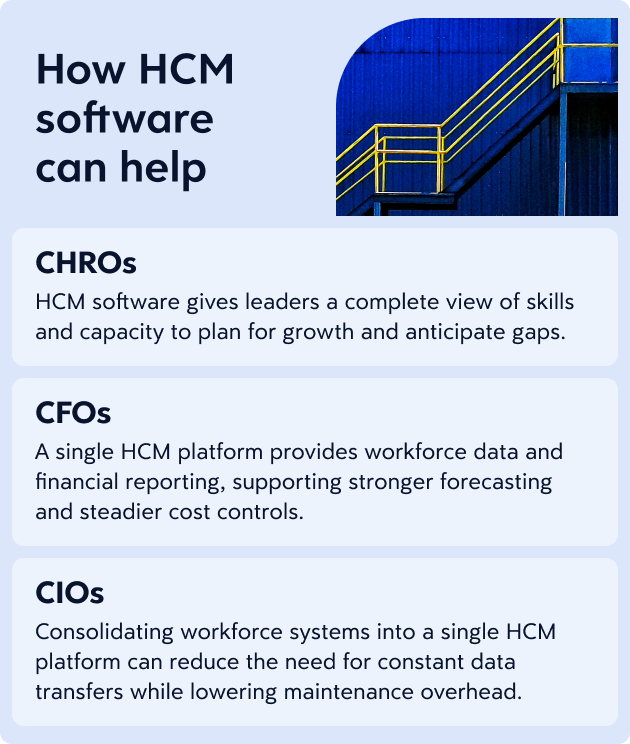
Chief human resource officers (CHROs) are accountable for talent pipelines, engagement, culture, and upskilling, as well as for helping the organization adapt as skill requirements evolve. A single HCM platform supports all of it, giving leaders a complete view of skills, business agility, and capacity to plan for growth and anticipate gaps.
It also creates a better experience for employees and managers. When key data follows people through their entire tenure, it can support a more consistent and connected employee experience.
CFOs: Make confident decisions
Labor rarely behaves like a fixed expense. Overtime can unexpectedly rise and compliance gaps can surprise you during critical times, like during audits.
These are the types of issues that should be detectable in real time, before they become entrenched and difficult to resolve. This is possible when workforce data and financial reporting align in a single HCM platform.
Within such a system, chief financial officers (CFOs) and other financial leaders can see how headcount changes or scheduling adjustments affect margins before the impact shows up in quarterly results. This level of visibility supports stronger forecasting and steadier cost controls.
CIOs: Simplify enterprise architecture
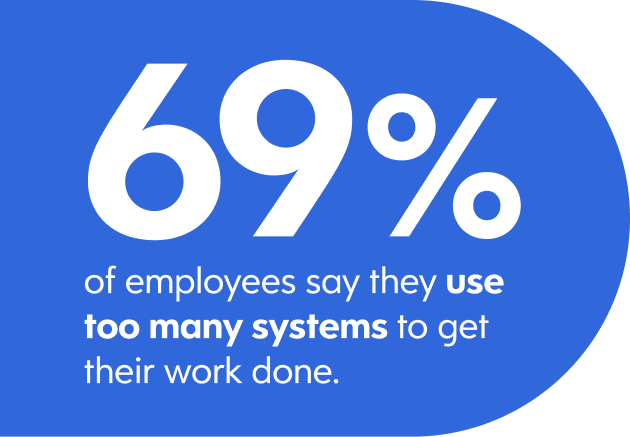
In Dayforce research on organizational friction, 69% of employees said they use too many systems to get their work done, and 66% said technology rollouts often reduce efficiency instead of improving it.
Chief information officers (CIOs) know this tension well. A recruiting system here, a payroll system there, and soon integration efforts can become fragmented and hard to maintain.
Consolidating workforce systems into a single HCM platform can reduce the need for constant data transfers while lowering maintenance overhead. That can give IT teams more time to support strategic initiatives versus constantly troubleshooting integration issues.
5 key benefits of human capital management
HCM benefits extend far beyond the human resources department. When your workforce information and data live on a single platform, leaders can make faster decisions with more consistent, current information.
Over time, that value compounds as workforce management shifts from reactive administration to deliberate business oversight.
Here are five top interdepartmental benefits of HCM.
1. Cost control
Labor costs rarely spike all at once. They tend to creep upward through increases in overtime, duplicate systems, the need for manual payroll corrections, and inefficient scheduling.
Combining workforce tools into one HCM platform reduces licensing overlap and cuts down on reconciliation work. It also helps limit payroll errors, each of which can cost companies hundreds of dollars to fix.
In addition, when leaders see labor trends in real time, they can act by making immediate cost-savings adjustments rather than course-correcting based on end-of-quarter reports.
2. Risk reduction
Risk exposure can silently build in organizations without a system to alert their teams to potential compliance issues. In fact, a recent HR Research Institute survey found that just one-third of organizations take a proactive approach to labor law compliance.
This can lead to wage and hour violations or misclassified workers emerging long after underlying issues begin, sometimes during an audit.
When employee records and pay data live in the same system as policy rules, discrepancies can become easier to detect early. A single HCM platform can help your organization manage its reliance on manual checks, which can help strengthen audit readiness.
3. Greater efficiency
When processes live in separate silos, teams often spend hours simply validating data before acting on it. Manual handoffs between HR, payroll, operations, and other departments take time that could be spent on higher-value work.
Working from a single platform and data model helps reduce duplicate and conflicting entries and can shorten approval cycles across the board. Among the core benefits of human capital management software are greater efficiency and the ability to scale processes without an equal growth in overhead.
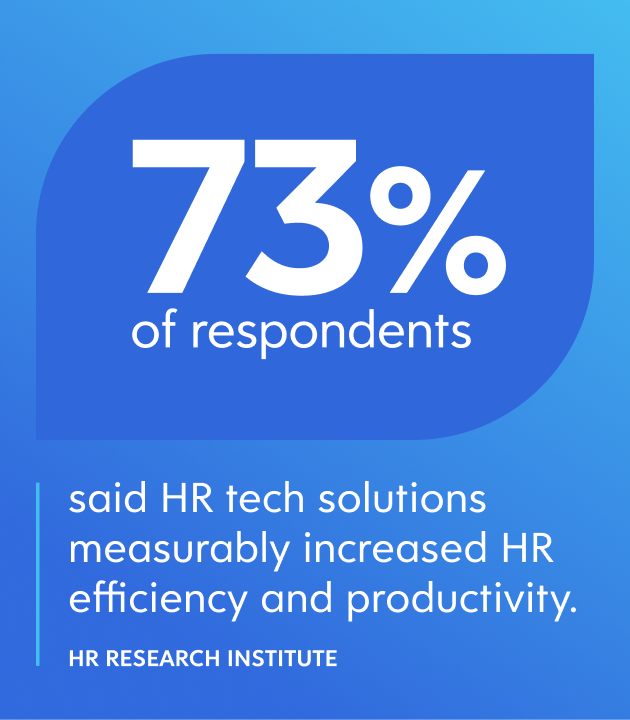
According to HR Research Institute research, 73% of respondents said paid HR technology solutions measurably increased HR efficiency and productivity, and 68% said they improved organizational efficiency and productivity.
4. Improved engagement
Employees notice when they work within disconnected systems. Being forced to re-enter information or wait for a payroll correction can erode trust, especially when career development opportunities are difficult to access.
Dayforce research on organizational friction points to the downstream effects. Forty-one percent of workers said they can’t complete their work because of insufficient staffing, and 25% said processes are too complicated. When friction is that pervasive, engagement suffers.
A single HCM platform helps address this, giving workers reliable access to payroll details and clearer visibility into their development goals. When people feel more informed and in control, satisfaction grows and managers spend less time resolving preventable issues.
Gallup estimates that 42% of employee turnover is preventable, making engagement a cultural (and financial) priority.
5. Data-driven decision making
Workforce decisions carry a lot of financial weight. A change in headcount, a poorly timed promotion, or a seemingly trivial shift adjustment can all affect labor costs and margins.
With connected workforce data, leaders can more proactively evaluate trade-offs using up-to-date information rather than monthly status reports. Clear, actionable insight into labor trends supports faster decisions that are more grounded in today’s reality than hindsight.
Building a business case for an HCM solution
Even when the need seems obvious, executive alignment depends on a clear financial and operational rationale.
A strong HR technology business case connects today’s pain points with measurable improvements, then tests whether a proposed solution can realistically deliver on that promise.
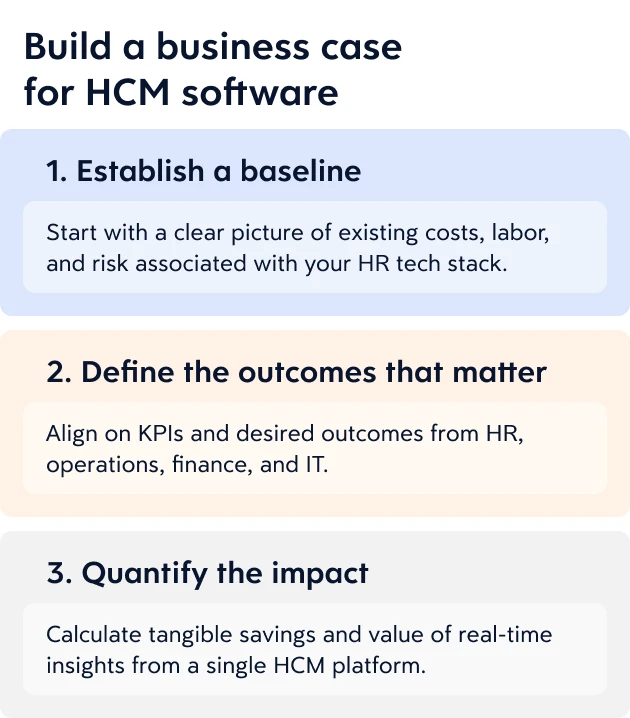
This process often follows three steps:
- Establish your baseline. Document the current state and complexity of your HR stack. How much time does your team spend reconciling data between systems? What is your payroll error rate? Which vendors do you work with, and how many integrations support current core workforce processes? A credible business case starts with a clear picture of existing costs, labor, and risk.
- Define the outcomes that matter. Which key performance indicators (KPIs) matter most to HR, operations, finance, and IT? How will you use these KPIs to measure the outcomes that matter most to you, like better efficiency or improved integration controls? The more closely these KPIs align with cross-functional goals, the stronger the business case for a single HCM platform.
- Quantify the impact. Calculate the tangible savings you expect to see, such as fewer vendor contracts or a reduction in errors. Then consider the cost of avoidable risks and the value of improved real-time insights. Pressure-test the solution you’re considering. Can it realistically deliver the results you need, and can you connect the software investment to improvements your business can clearly measure?
Turn HCM into measurable outcomes
A strong business case for an HCM solution is grounded in evidence. The most effective proposals show how HCM benefits translate into tighter cost controls and clearer compliance oversight, improving workforce planning across your organization.
When HR, finance, and IT align around shared metrics, progress is visible and defensible. Leaders gain clearer control over labor spend and greater confidence during audits, while decisions move forward with more confidence.
For a deeper framework on evaluating HCM platforms and defining what success looks like, explore our complete HCM software buyers’ guide.
Frequently asked questions
What are the benefits of human capital management?
The primary benefit of an HCM solution is that an organization’s workforce data lives in one place. This gives leaders better visibility into labor costs and compliance exposure, while employees experience more consistency across pay and professional development. This clarity can reduce operational friction and support more efficient performance over time.
Why is human capital management important for growing companies?
Growth adds pressure to systems that may have once felt manageable. A few new teams or a move into another region can expose gaps in reporting and compliance. HCM software provides structure as complexity increases, so growth doesn’t introduce unnecessary risk.
What business outcomes does HCM improve most often?
Organizations that consolidate systems through a single HCM platform often gain tighter control over labor spending. Payroll corrections can decline because data flows from a single source. Planning conversations can also improve, since the workforce and financial reporting reflect the same numbers and KPIs.
What are common objections to HCM, and how do you address them?
Cost is usually the first concern, with the strain of implementation close behind. Effectively responding to these objections starts with documenting your organization’s current challenges. When reconciliation time, integration overhead, and error rates are visible and measurable, the trade-offs become easier to evaluate.
How do you build cross-functional support for an HCM business case?
Start by identifying shared metrics instead of system features. Finance focuses on margin stability, IT on load and integration, and HR on reliable workforce insight. When each department can see how a single platform and data model can support its priorities, consensus for an HCM often builds naturally.
You may also like:
Ready to get started?