HCM system selection: How to choose the right platform for your organization
Choosing an HCM platform is a high-stakes, cross-functional decision that should start with aligning stakeholders and defining clear selection criteria based on your organization’s current pain points. The article outlines the selection process step-by-step.


Table of Contents
Key takeaways
Step 1: Align stakeholders
Step 2: Identify current challenges
Step 3: Turn desired outcomes into selection criteria
Step 4: Build a vendor shortlist
Step 5: Run demos using real scenarios
Step 6: Watch for red flags that signal future risk
Step 7: Shift from promises to proof points
Step 8: Choose an HCM platform that supports your work
Frequently asked questions
Table of Contents
Key takeaways
Step 1: Align stakeholders
Step 2: Identify current challenges
Step 3: Turn desired outcomes into selection criteria
Step 4: Build a vendor shortlist
Step 5: Run demos using real scenarios
Step 6: Watch for red flags that signal future risk
Step 7: Shift from promises to proof points
Step 8: Choose an HCM platform that supports your work
Frequently asked questions
Selecting an HCM system is one of the more consequential technology decisions an organization can make. After all, the platform you choose will shape day-to-day operations, risk management, and long-term growth, potentially for years to come.
We’ll walk you through a methodical, strategic approach to finding the right HCM software, from taking inventory of your firm’s current needs to getting the most out of platform demonstrations. That way, you can move forward with confidence.
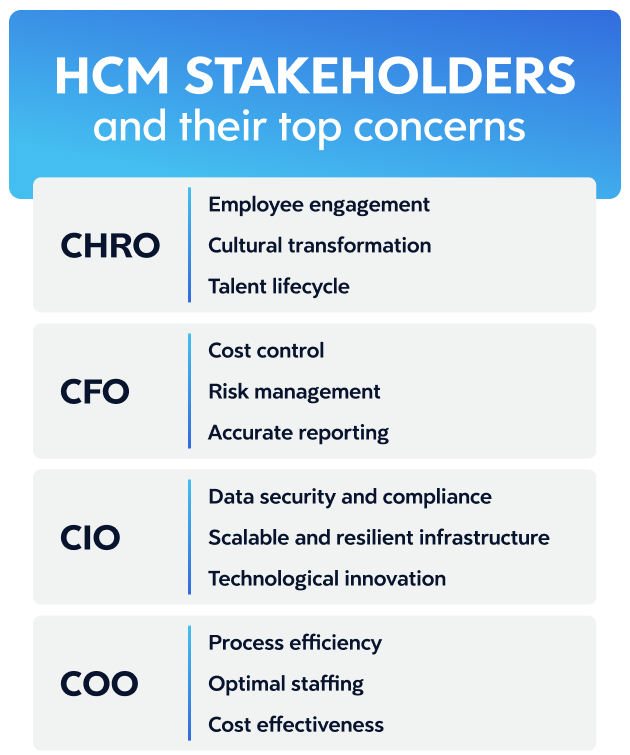
Your exact team roster may vary in size and composition, but these stakeholders should be involved:
Beyond each functional area’s needs, your HCM system selection team should align on shared objectives, including:
Compile information like:
During the HCM system selection process, distinguish clearly between needs and wants. Ranking capabilities helps your team make informed trade-offs if you run into budget constraints. Many HCM platforms, including Dayforce, also let you add functionality over time, so a phased approach doesn’t have to mean settling.
Ask to see how the platform handles the critical objectives you identified in steps two and three. For example, you might request a live demonstration of how a single data entry triggers a system-wide update. In this case, the goal is to evaluate the platform’s data model under realistic conditions.
For more guidance, read our HCM software buyer’s guide and take the next step toward a platform that helps your people do the work they’re meant to do.
We’ll walk you through a methodical, strategic approach to finding the right HCM software, from taking inventory of your firm’s current needs to getting the most out of platform demonstrations. That way, you can move forward with confidence.
Key takeaways
- HCM system selection is a multi-step process that requires many stakeholders to get (and stay) on the same page.
- Your selection team should convert current HR-related pain points into a list of criteria your new HCM system must meet.
- Take control of product demonstrations early to make sure they address your specific needs rather than turning into generic marketing presentations.
- Watch for potential red flags and ask for real proof of value before committing.
Step 1: Align stakeholders
Choosing the right HCM platform for global workforce administration starts with assembling a cross-functional team of key stakeholders. The HCM system will impact your entire organization, so input from various functional leaders is essential.Your exact team roster may vary in size and composition, but these stakeholders should be involved:
- Chief Human Resource Officer (CHRO)
- Chief Financial Officer (CFO)
- Chief Information Officer (CIO)
- Chief Operations Officer (COO)
| Stakeholder | Top concerns |
|---|---|
| CHRO |
|
| CFO |
|
| CIO |
|
| COO |
|
Beyond each functional area’s needs, your HCM system selection team should align on shared objectives, including:
- Strong data accuracy and security
- Increased productivity
- Increased compliance
- Affordability and value
- Support for employees across every jurisdiction where your organization works (or plans to)
Step 2: Identify current challenges
You can’t get where you want to go unless you know where you’re starting from. That means HCM system selection can’t happen without starting with an honest assessment of how your HR department operates today.Compile information like:
- Processes that work well, and processes that don’t
- Nagging pain points, such as manual data entry or inadequate reporting capabilities
- Your current HR tech stack’s capabilities
- Department goals (short and long term)
Step 3: Turn desired outcomes into selection criteria
Now, convert your HR department’s pain points and objectives into a list of specific, testable HCM system capabilities. Here are some criteria to get you started:| HR department objectives | HCM system features |
|---|---|
| Process payroll faster | Automated payroll calculations |
| Improve employee data accuracy | Single data model and shared rules spanning the entire HCM lifecycle (a universal database for all modules means you enter data once, and it updates automatically system-wide) |
| Strengthen audit readiness | Built-in audit trails |
| Improve the employee experience | Employee self-service options |
| Strengthen workforce planning (and make it more accurate) | Labor forecasting |
| Simplify the tech stack | Single-platform architecture |
| Implement a scalable solution | A platform designed to grow with your organization without added complexity |
Step 4: Build a vendor shortlist
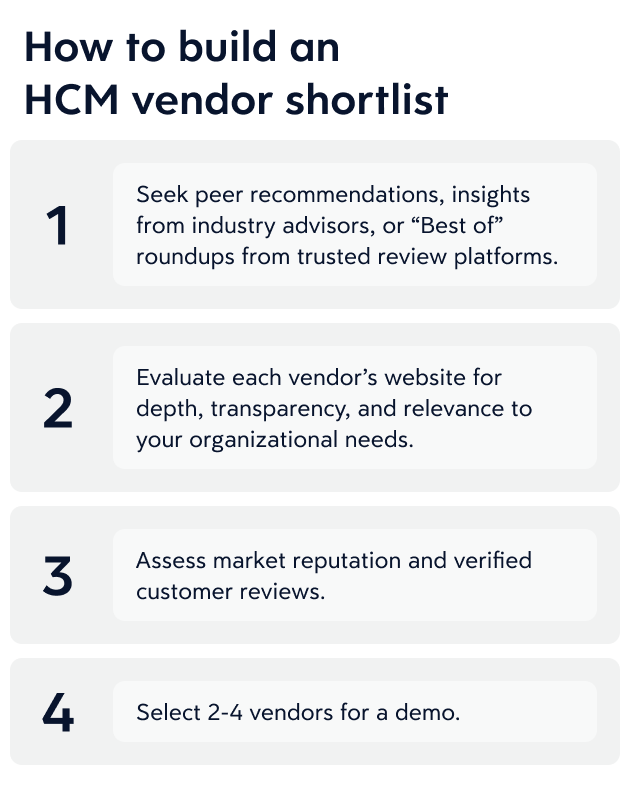
With your criteria in hand, build a shortlist of vendors to consider. Strong starting points include:- Peer recommendations from organizations of similar size and complexity
- Insights from industry advisors
- Reputable analyst reports and “best of” roundups from trusted review platforms
- Evaluating each vendor’s website for depth, transparency, and relevance to your needs
- Reading detailed product reviews from verified customers
- Assessing each vendor’s market reputation and customer base
Step 5: Run demos using real scenarios
Vendors will showcase flashy system capabilities during demonstrations to wow you. But to make this step of the HCM system selection process genuinely relevant to your company, redirect the conversation toward your organization’s specific use cases rather than letting the vendor control the agenda.Ask to see how the platform handles the critical objectives you identified in steps two and three. For example, you might request a live demonstration of how a single data entry triggers a system-wide update. In this case, the goal is to evaluate the platform’s data model under realistic conditions.
Step 6: Watch for red flags that signal future risk
A vendor’s claims and product demonstration may leave you impressed, but there could be potential pitfalls lurking beneath the platform’s surface. As you evaluate vendors, watch for warning signs that could indicate deeper problems down the line:- The platform relies on multiple data models, which can cause consistency issues and make long-term maintenance more complicated.
- The vendor routinely uses partners to provide geographic coverage, which might lead to inconsistent user experiences and compliance concerns.
- The system’s AI capabilities aren’t well-documented or can't be configured, which may indicate transparency or governance issues.
Step 7: Shift from promises to proof points
When you invest this much time and money into implementing a new HCM system, you want to be reasonably confident that the tool will perform as advertised. Here are some ways to vet the system’s capabilities before signing a contract:- Have an analyst validate the platform’s architecture and maturity.
- Look for vendor certifications, such as ISO 42001, which demonstrate commitment to system security.
- Ask the vendor how you can track your return on investment (ROI) post-implementation.
- Collect testimonials from similar companies about measurable improvements noted post-implementation.
Step 8: Choose an HCM platform that supports your work
The right HCM system selection makes the work easier, so your team can spend more time fulfilling your company’s mission. Look for a solution that connects people, data, and decisions in one place and in real time, one that can adapt to your organization’s changing needs.For more guidance, read our HCM software buyer’s guide and take the next step toward a platform that helps your people do the work they’re meant to do.
Frequently asked questions
What are the most important HCM selection criteria?
The most important HCM system selection criteria include (but aren’t limited to):- Features that fit your company’s specific use cases
- Compatibility with the other software and apps your organization relies on
- Configurable analytics and advanced reporting
- Continuous innovation, including the addition and refinement of AI tools
- A proven implementation framework
- A clear and transparent fee structure
- A stable, efficient, and scalable architecture
- Compliance support across all jurisdictions in which your company operates
- Multiple layers of system and data security
- Dependable, expert support whenever you need it
- A positive vendor reputation
What questions should be included in an HCM vendor shortlist?
Vendor demos can make most platforms look similar. A shortlist of targeted questions will help you identify meaningful differences quickly. Some things to ask include:
- Who handles the implementation and how long will it take?
- Will your company get a dedicated service team?
- How easy is it to add features and functionality as your company grows?
- Can system administrators make basic changes, such as adding job titles, without needing to touch code?
It’s also a good idea to request a service level agreement (SLA) that covers the vendor’s uptime requirements and support options.
What should professional services firms prioritize in HCM selection?
Any HCM system recommended for professional services firms should support client delivery work. Key capabilities to prioritize might include:- Project-based time tracking
- Multi-jurisdiction payroll (if you operate across regions)
- Contractor management
- Certification, license, and training tracking
- Employee utilization rate tracking
- Resource forecasting
How do you validate integrations with payroll, finance, and time systems?
Here are a few practical steps that can help verify that a platform will work with your existing tools:- Ask the vendor to show you how data moves between systems, whether natively, through an API, or via file transfers.
- Connect a sandbox HCM environment to a test payroll or financial system and create a new hire in the sandbox HCM environment. Then, see if the new hire’s timesheet flows into payroll, and if the pay run flows into your accounting software.
- Ask existing customers about their experiences with data accuracy and system reliability over time.
Who should be involved in choosing an HCM system?
HCM system selection isn’t just an HR decision. While specific stakeholder titles will vary based on your company size, industry, and other factors, leaders from these departments should be involved:- HR (including various functions, like recruiting and benefits)
- Payroll
- Finance
- IT
- Legal
- Procurement
- Operations
You may also like:
Ready to get started?