Who is involved in selecting HCM software?
The HCM platform your organization chooses is shared infrastructure. Getting that decision right requires having the right people in the room to steer it. Here’s how to build a cross-functional buying committee that aligns stakeholders on outcomes before vendors enter the picture.


Table of Contents
This guide explains who belongs on that committee and how to make sure the group lands on the right HCM platform for your organization.
Key takeaways
- An HCM buying committee should include stakeholders from HR, finance, IT, and operations, as each group owns a different outcome that the system affects.
- Clear roles and governance keep the selection process moving forward without confusion about who evaluates and who approves the final decision.
- Early agreement on priorities, including “must-haves” and “nice-to-haves,” helps the team focus on business outcomes rather than feature lists.
- Strong cross-functional collaboration can make it easier to build a business case and get approval for a new HCM platform.
- Effective committees treat HCM software as shared infrastructure and evaluate platforms based on long-term fit.
Building an HCM buying committee
An HCM buying committee is made up of stakeholders from departments most affected by the new software. Their job is to select the platform that best serves each team’s needs and the organization’s direction over time.The reason a committee makes sense is that single-system HCM platforms extend across an organization’s people and departments. That includes payroll, recruiting, operations, data analytics, and even employee onboarding and development.
Strong stakeholder alignment when making an HCM selection helps these teams move forward with a shared understanding of what matters most for each discipline.
An HCM buying committee will typically define requirements, evaluate vendors, weigh functional needs, and build consensus around a new system. Without that alignment, decisions can stall or shift late in the process.
Core HCM decision-makers and what matters to each
Each stakeholder on the committee is responsible for different outcomes. These stakeholders across HR, payroll, IT, and finance bring distinct perspectives and priorities that shape the final decision.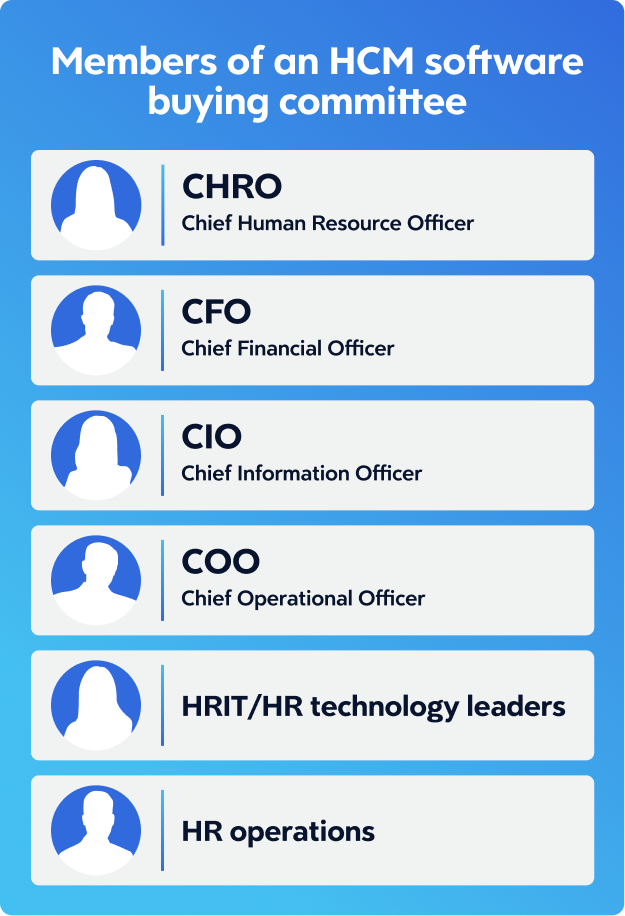
Chief human resource officers (CHROs)
Often the leader of the HCM buying committee, the CHRO tends to evaluate platforms with a long-term workforce strategy in mind. That means prioritizing talent pipelines and skills visibility as they pertain to internal mobility and an organization’s capacity to adapt. CHROs need a connected view of where capabilities exist today and where gaps are emerging.In the shorter term, employee adoption also matters to CHROs. If the platform is difficult to use, even its best capabilities will fall short in practice.
Chief financial officers (CFOs)
CFOs will typically focus on financial impact and risk. They want to understand how the platform supports accuracy in areas such as payroll, how it helps their company manage compliance, and whether it can provide actionable insight.Cost is another primary consideration for CFOs, though this is usually considered alongside long-term value and operational stability.
Chief information officers (CIOs)
The CIO is responsible for understanding how a new HCM platform fits into the broader technology environment. That means looking closely at architecture, interoperability, data security, and how the platform will scale as the organization grows.CIOs may also play an important role in evaluating AI capabilities and how they fit into the organization’s broader AI strategy. That includes assessing whether the platform’s AI is supported by reliable data, appropriate governance, clear security controls, and practical use cases that can create value without introducing unnecessary risk.
They also watch for red flags that indicate software may require heavy integrations or ongoing maintenance work to stay current. The goal is a platform that holds up over time, not one that creates new technical problems while solving operational ones.Chief operating officers (COOs)
The COO cares about how workforce decisions affect daily execution, especially in retail and manufacturing environments where scheduling, labor costs, productivity, and compliance are tightly connected. They want an HCM platform that helps teams stay agile and aligned with operational demand.HRIT/HR technology leaders
HRIT and HR technology leaders understand how HCM software works in practice across teams, processes, and data flows. They often sit between HR, IT, payroll, and other functional leaders, helping translate business needs into system requirements.
This group may evaluate how easily a platform can be configured, how data moves across the HCM life cycle, and whether the system can reduce manual work instead of adding more operational complexity. Their perspective is especially important when assessing implementation effort, ongoing maintenance, reporting reliability, and the long-term scalability of the platform.
HR operations
HR managers and operations teams focus on how day-to-day work gets done, making usability and adoption a primary concern. A new system must support and simplify daily processes without adding extra steps. Clear workflows and reliable data help these teams support the business without forcing them to spend time correcting issues behind the scenes.Depending on the organization’s structure, functional leaders from payroll, talent acquisition, learning and development, rewards, or workforce management may also contribute requirements tied to their specific areas of responsibility.
A practical HCM selection governance model
Too many cooks in the kitchen can quickly become a problem when making big software decisions. Multiple stakeholders without clear ownership or roles can diminish momentum.A simple three-layer governance structure keeps the right voices in the process without stalling the decision. When each layer has a good sense of its role, the procurement process for HCM software moves faster and tends to produce fewer surprises at the end.
Executive sponsor
An executive sponsor, often the CHRO, is responsible for establishing direction and securing budget support for the new HCM software. This person helps connect the project to broader organizational priorities and ushers the project forward when decisions stall.Steering committee
The steering committee is often made up of leaders from HR, finance, IT, and payroll. This influential team evaluates options, reviews trade-offs, establishes must-haves, and guides the final selection decision. The executive sponsor may lead these meetings or delegate to a project owner, but major decisions belong to the committee.Working team
The working team manages the day-to-day evaluation work. Members gather requirements from their respective departments, attend demos, document findings, and plan for implementation. This group may include HR operations, payroll specialists, IT analysts, and procurement.How to align the CHRO, CFO, and CIO on HCM priorities
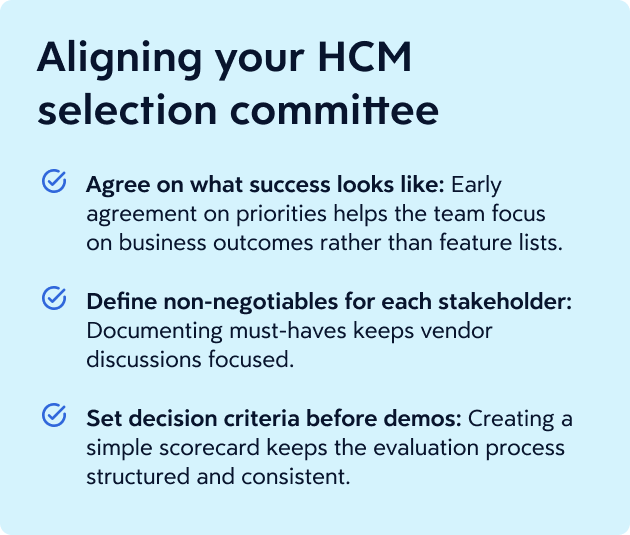
An HCM buying committee does its most important work well before the first vendor demo. Teams must first sync on overall needs and priorities, so the evaluation process stays focused and decisions don’t stall later. They do this by:
Starting with outcomes
Alignment usually begins with agreement on what success looks like. Leadership teams, for example, often want better visibility into the workforce or a system that can support growth without constant fixes or integration issues. When a group agrees on the outcomes first, the conversation can shift from software features to actual business results.Defining non-negotiables for each stakeholder
Each leader will have a handful of priorities that must be met. HR may require a single data model spanning the HCM life cycle and strong workforce reporting. Finance may focus on compliance and cost control. Security, system architecture, AI governance, and fit with the organization’s broader AI strategy will be important to your IT department. Documenting these must-haves early on helps prevent confusion later when vendors start making their case.Agreeing on decision criteria before vendor demos
Before shortlisting vendors, the committee should agree on how it’ll evaluate options. It’s common for an organization to create a simple scorecard built around requirements, risk tolerance, and implementation. This keeps the process structured and consistent, helping the HCM buying committee make decisions grounded in shared criteria rather than individual preference.Bringing perspectives together for HCM selection
The reason HCM selection works best as a shared process is simple: The platform will be the infrastructure that every team depends on. HR, finance, IT, and payroll all work from the same data. When these teams align on priorities early, building a business case and securing approval for a new HCM solution can be a much more straightforward process.For more guidance on evaluation criteria, explore our complete HCM software buyer’s guide.
Frequently asked questions
Who is involved in selecting HCM software?
Most organizations form an HCM buying committee made up of HR, finance, IT, payroll, and sometimes operations or procurement. Each group evaluates the platform from a different angle, which helps the organization choose a system that works across the business.Who typically owns the HCM decision: HR, IT, or finance?
It’s common for HR to lead the selection team because the platform supports the employee life cycle. However, the final decision is often shared with finance and IT since HCM platforms affect payroll, reporting, worker buy-in, and system architecture. Often, the CHRO serves as the executive sponsor.What role does payroll play in HCM software selection and approval?
Payroll teams play a critical role due to their expertise in pay rules, compliance requirements, and the day-to-day realities of payroll operations. Their input often shapes requirements for pay accuracy and audits, as well as overall system reliability.What is a good governance model for HCM software selection?
A common approach includes an executive sponsor, a steering committee, and a working team. The working team evaluates systems and gathers requirements. The steering committee reviews findings and makes recommendations. The executive sponsor approves the final direction and secures funding.How do you align the CHRO, CFO, and CIO on HCM priorities?
Start by agreeing on what the organization needs to improve. Then document the HCM platform requirements each leader considers essential. Once those priorities are clear, the committee can evaluate vendors using shared criteria rather than individual preferences.You may also like:
Ready to get started?