From decision to deployment: HCM platform timeline and transition plan
Choosing an HCM platform is only half the job. The real challenge is getting from decision to go-live without surprises. Here’s a practical HCM project plan, including a realistic timeline you can use to align teams and keep the process moving.


Table of Contents
You’re confident it’s time to move forward with an HCM platform. Now the question is how to turn that decision into a realistic HCM project plan. From vendor selection to implementation and go-live, the full journey can take several months.
Here, we connect each stage into one timeline you can use to set expectations across teams before the HCM platform launch happens.
For instance, your current processes and tech stack may:
Document each stakeholder’s priority early and keep them top of mind throughout the selection process. The platform you choose will need to meet critical needs across functions to be a worthwhile investment.
Send a request for proposal (RFP) to the vendors on your list, setting a firm deadline for responses. Have each committee member carefully review and rate each response on a standardized scorecard.
Ideally, the top three to five vendors will receive further consideration in the next phase.
For a deeper framework, including selection criteria and common pitfalls to avoid, explore our HCM software buyer’s guide.
Here, we connect each stage into one timeline you can use to set expectations across teams before the HCM platform launch happens.
Key takeaways
- Your HCM selection timeline could take up to eight months, depending on company size, goals, and other variables.
- Start the process by building a business case for the new platform and getting selection committee members aligned on HCM platform requirements.
- Cast a wide net early, requesting proposals from multiple vendors offering plausible solutions.
- Book product demonstrations and complete due diligence for your top picks before negotiating a contract.
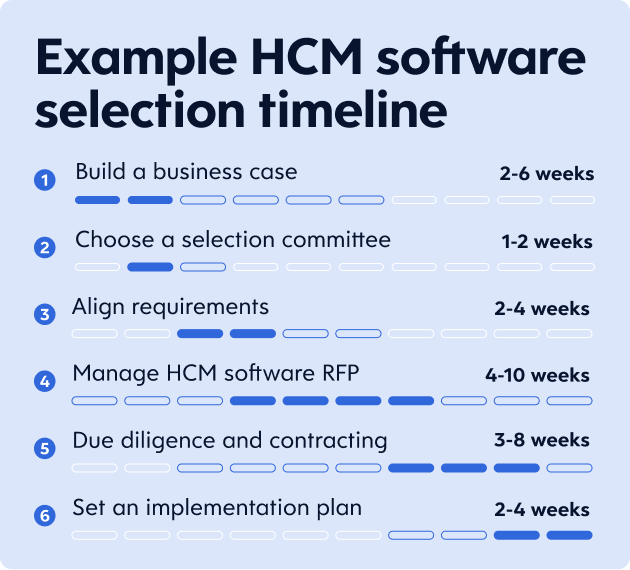
The end-to-end HCM selection timeline
Before a single vendor conversation happens, there’s a lot of work to do. The first several weeks (sometimes closer to two months) involve internal groundwork that sets the foundation for everything that follows.
Building a business case
The first phase of your HCM project plan is all about building a business case that resonates beyond HR. Over the next two to six weeks, you’ll spell out exactly why you need a new platform by combing through existing processes and identifying pain points.For instance, your current processes and tech stack may:
- Be inefficient, requiring repeated manual effort
- Lead to frustrating and disruptive outcomes, like payroll errors or long time-to-fill periods
- Generate poor-quality reports that hinder effective decision-making
Choosing a selection committee
Plan a week or two to assemble a selection committee. Since an HCM platform will impact HR, payroll, finance, IT, and operations, these roles should be represented (at a minimum):| Position | Primary concern |
|---|---|
| CHRO | Shaping the workforce and employee experience |
| CFO | Strengthening financial confidence and forecasting |
| CIO | Simplifying the organization’s technology infrastructure |
| HR manager | Supporting leaders and employees well |
| Payroll leader | Paying employees accurately and on time |
Aligning selection requirements
Over the next two to four weeks, your selection committee should identify and document the requirements for the new HCM platform. Example requirements include:- Single data model (to keep employee data organized in a central location)
- Labor cost visibility controls
- Scalability across workforce types and regions
- Clear approval chains
- Audit logs and change tracking
- Custom reporting capabilities
- AI-assisted recruiting tools
- Payroll and time automation
Managing the HCM RFP process
It’s time to start looking at software and talking to vendors. During the next four to 10 weeks of the HCM selection timeline, compile a list of up to a dozen potential vendors. You can source candidates through peer referrals, analyst research, or reputable software review sites.Send a request for proposal (RFP) to the vendors on your list, setting a firm deadline for responses. Have each committee member carefully review and rate each response on a standardized scorecard.
Ideally, the top three to five vendors will receive further consideration in the next phase.
Due diligence and contracting
The next three to eight weeks are often intensive as you take a fine-tooth comb to each potential system — and the vendors behind them. Key tasks for your selection committee include:- Participating in product demonstrations built around your real use and edge cases
- Asking current and, when possible, recent customers about their experiences
- Reviewing the technical aspects of the system, such as integrations, data architecture, and implementation readiness
- Assessing security features and practices (It’s a good sign if the vendor can show you a SOC 2 Type II report.)
Setting an HCM implementation plan
Once you finalize your decision, you’ll spend the next two to four weeks developing HCM implementation steps. Typically, your implementation plan will be guided by the HCM provider, based on their methodology and best practices. Your detailed deployment steps should include major project milestones, including:- System configuration
- Data cleaning and migration
- Testing (including edge cases)
- Training for all users
- Your go-live date
Starting the search for an HCM solution
When deploying an HCM system is new territory, the road from selection to go-live can feel a little daunting. A clear HCM project plan helps you break the work into phases, keeping you and your selection committee on track over the next three to eight months.For a deeper framework, including selection criteria and common pitfalls to avoid, explore our HCM software buyer’s guide.
Frequently asked questions
What is an HCM implementation plan for executives?
An HCM implementation plan for executives is a step-by-step procedure to effectively deploy the system across the organization. The plan will include desired outcomes, project milestones, and a realistic timeline.What is a realistic HCM selection timeline?
Your HCM selection timeline will vary based on your company size, the number of stakeholders contributing input, and other factors. However, you can realistically expect the process to take anywhere from three to eight months.Who should own the HCM transition across HR, payroll, IT, and finance?
HR, payroll, IT, and finance are all equally responsible for the HCM transition. Leaders from each business function must work closely together throughout the HCM selection and implementation processes.What does the HCM RFP process include at a high level?
The HCM RFP process includes identifying potential vendors and asking them to submit an RFP. Then, the HCM selection committee will review the submissions to determine which vendors will make it to the product demonstration and due diligence round.What should be included in an HCM implementation readiness checklist?
An HCM implementation readiness checklist should include items like:- Assemble an implementation team and assign each member a role.
- Confirm technical compatibility and security requirements.
- Prepare and map data for migration.
- Design future-state workflows and approvals.
- Inventory integrations and data sources.
- Draft change communication.
- Develop a testing plan.
- Create training materials and develop a training plan.
- Determine a go-live date.
- Develop a cut-over strategy and backup plan.
You may also like:
Ready to get started?