What is Payday Super? A complete guide for Australian employers
Learn what Payday Super means for Australian employers, including key changes, deadlines, compliance risks, and how to support compliance starting July 2026.


Table of Contents
Table of Contents
Payday Super is one of the most significant changes to Australia’s superannuation system in decades. Starting 1 July 2026, employers are required to pay super contributions at the same time as employee wages, rather than quarterly.
This is a structural shift in how super is paid, reported, and funded that raises the stakes for payroll accuracy, governance, and cost control. Moving from something that happens four times a year to every pay cycle means up to a minimum 12x increase in pay frequency, depending on whether staff are paid monthly, fortnightly, or weekly. Higher frequency increases transactions and visibility while shrinking the margin for error—adding complexity and risk.
In this guide, we answer the most common questions about Payday Super, what it means for your business, and how to prepare.
What is Payday Super?
Payday Super is an Australian regulation effective as of 1 July 2026 that requires employers to pay superannuation contributions at the same time as wages, with funds received within 7 business days. It replaced the quarterly super payment model with real-time, pay-cycle-based compliance reporting via Single Touch Payroll (STP).
Why does Payday Super matter for Australian employers?
Payday Super represents a shift from periodic compliance to continuous, real-time payroll obligations. For employers, this means:
- More frequent super payments (up to 12x more per year or higher)
- Increased payroll complexity and processing volume
- Greater ATO visibility through real-time data
- Reduced tolerance for errors or delays
Industries with high-frequency or award-based payrolls—such as retail, hospitality, aged care, manufacturing, and construction—will likely experience the greatest operational impact.
When does Payday Super start in Australia?
Payday Super is in effect as of 1 July 2026.
The ATO has indicated it will take a risk-based approach during the first year (1 July 2026 – 30 June 2027). Read about what Payday Super means for organisations direct from the Australian Taxation Office (ATO) in this recap of the Dayforce Summit Sydney session. For official guidance, see ATO's Payday Super overview.
How does Payday Super work in Australia?
Under Payday Super, super contributions become part of every payroll cycle:
- Employee earnings are calculated during payroll
- Super is calculated based on employee earnings
- Payroll data is reported to the ATO via STP
- Contributions are paid through a clearing house
- Funds must receive contributions within 7 business days
The ATO will use real-time STP data and analytics to monitor compliance and identify late, missing, or underpaid super contributions. Payroll shifts from a batch process to a real-time, compliance-driven function.
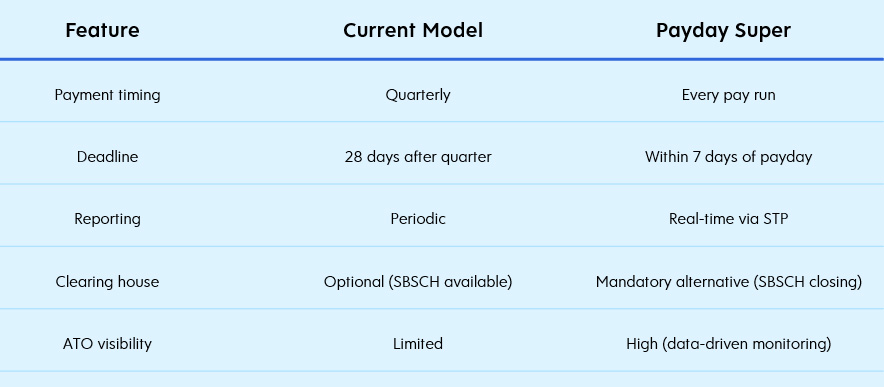
How is Payday Super different from the current system?
We've outlined the differences in this table:
Why is the Australian government introducing Payday Super?
According to the ATO, Payday Super aims to:
- Reduce late, missing, or underpaid super contributions
- Improve transparency for employees
- Enable real-time compliance monitoring through STP
- Strengthen long-term retirement outcomes
By aligning super payments with pay cycles, employees receive contributions sooner, allowing more time for investment growth.
What are the new compliance requirements under Payday Super?
Employers must:
- Pay super with every pay run
- Ensure funds are received within 7 business days
- Report payroll and super data via STP
- Accurately calculate and report Qualifying Earnings (QE)
These changes significantly increase compliance obligations and reduce tolerance for manual errors.
What does the closure of SBSCH mean?
The ATO Small Business Superannuation Clearing House (SBSCH) will close on 30 June 2026.
Employers will need to:
- Use a payroll system with built-in clearing functionality, or
- Integrate with a compliant SuperStream clearing house
This change increases reliance on payroll technology and makes system selection more important than ever. Learn more from the ATO here.
What are the biggest challenges of Payday Super for employers?
Key challenges include:
- Meeting the 7-day deadline - Super must be processed and received quickly, leaving little room for delays.
- Managing cash flow - Super shifts from quarterly payments to continuous outflows, requiring better forecasting.
- Handling increased payroll complexity - More frequent processing increases administrative workload and reduces the room for error—especially where manual processes, numerous spreadsheets, or disconnected workflows are involved.
- Ensuring data accuracy - Data quality is critical. Errors in payroll or employee data introduced through manual handling, rework, or inconsistent data sources can lead to failed payments, STP submission issues, and increased ATO scrutiny.
- Adapting internal workflows - Delays in approvals, timesheets, or onboarding can push payments outside compliance windows.
How are you managing Payday Super compliance?
See how Dayforce supports real-time compliance and accurate super payments.
Learn more
What are the penalties for late, missing, or unpaid super payments under Payday Super?
Non-compliance with Payday Super may result in:
- Super Guarantee Charge (SGC)
- Interest and administrative penalties
- Increased ATO audit and enforcement activity
- Reputational risk for employers
The ATO has indicated it will take a risk-based approach during the first year (1 July 2026 – 30 June 2027).
Employers who make genuine efforts to comply and fix errors quickly are less likely to be the focus of enforcement activity. Continuous compliance is essential as monitoring becomes more automated and data-driven.
How should businesses prepare for Payday Super?
Review your processes
- Move toward real-time or automated payroll operations
- Reduce manual steps and delays
Improve data quality
- Validate employee and super fund data
- Promote accuracy before each pay run
Test early
- Run mock pay cycles
- Identify gaps before the 2026 deadline
What should you look for in a Payday Super-ready payroll system?
A Payday Super compliant payroll system should include:
- Compliance and readiness
- Support full Payday Super compliance by 1 July 2026
- Ability to process super every pay run
- Super processing capabilities
- Built-in clearing house integration
- SuperStream-compliant
- Real-time payment tracking
- Fast handling of rejected contributions
- STP and reporting
- Support automated STP reporting
- Support and reconciliation for qualifying earnings (QE)
- Data accuracy and validation
- Pre-payroll checks to catch errors early
- Promote accurate employee and fund data handling
- QE validation to reduce the risk of miscalculations
- Automation and efficiency
- Help with automated calculations for pay, tax, and super
- Reduced manual intervention
- Built-in rules to handle complex scenarios and eligibility automatically
- Workflow optimisation
- Support automated approvals and reminders
- Faster payroll cycles
- Employee onboarding accuracy
- Capture super details correctly from day one
- Self-service for super choice and voluntary contributions
- Reduce failed contributions
- Visibility and risk management
- Continuous calculation for up-to-date payroll and super data
- Real-time insights into exceptions, including STP, missing super fund anomalies, and compliance risks.
- Compliance risk management
- Audit logs and reporting
- Tools to resolve issues quickly
- Cash flow planning
- Forecasting tools
- Integration with accounting systems
- Real-time labour cost insights to support funding decisions
What questions should you ask payroll providers about Payday Super?
When evaluating vendors, ask:
- Can your platform support compliance with Payday Super requirements?
- How do you ensure compliance with the 7-day payment window?
- How do you handle failed or rejected super payments?
- How is data validated before STP submission?
- Can we test payroll scenarios before go-live?
How can payroll software help with Payday Super compliance?
Modern payroll platforms can:
- Support automated super calculations and payments
- Submit STP reports in real time
- Validate payroll data before submission
- Provide visibility into compliance risks
This reduces administrative burden and helps support accuracy in a more complex regulatory environment.
Key takeaways
Payday Super requires employers to move from quarterly contributions to real-time, pay-cycle-based super payments. Contributions must be received within seven business days, and the ATO will use STP data to monitor compliance closely.
Success depends on having:
- Automated payroll processes
- High-quality, validated data
- Systems capable of real-time reporting and compliance
For many organisations, Payday Super represents a broader shift toward continuous payroll operations.
Prepare for Payday Super with confidence
Payday Super requires a new approach to payroll—one that is continuous, promotes accuracy, and supports compliance by design. Explore how Dayforce helps Australian employers efficiently manage super payments, support STP compliance, and reduce payroll risk.
See how Dayforce can help
More Payday Super resources:
Ready to get started?