What payroll leaders need to know about Payday Super - direct from the ATO
Payday Super is one of the biggest payroll changes in years. Hear directly from the ATO about what's changed, where challenges may arise, and how payroll teams can support its requirements.


Table of Contents
Table of Contents
The Dayforce Summit session on Payday Super opened with a question to the room: how many people here had personally been affected by unpaid super, or knew someone who had?
Most hands went up.
The response highlighted the scale of the issue the Australian Tax Office (ATO) is trying to address. According to its analysis, $6.2 billion in super goes unpaid each year, amounting to around $1,700 in lost retirement savings per working Australian.
With just over a month until go-live at the time of the session, the conversation between Shane Moore, ATO Project Director for Superannuation and Employer Obligations, and Jason Low, Head of The Association for Payroll Specialists (TAPS), focused less on legislation and more on operational reality.
For payroll leaders, Payday Super represents one of the biggest operational changes in payroll in years. Alongside payment timing, organisations are now working through new reporting requirements, greater visibility into payroll data, and far greater pressure on payroll data accuracy.
Here's what payroll leaders most need to understand as the legislation comes into effect on 1 July 2026.
The visibility gap Payday Super is designed to close
According to the ATO, unpaid super under the quarterly model has rarely been driven entirely by deliberate avoidance.
“In a quarterly system, larger payment amounts mean mistakes can be harder to find, so when you fall behind, the amounts can be significant,” said Moore. “And by the time the ATO comes in to chase any unpaid super, many of those businesses have closed down.” Payday Super shortens the gap between when super is owed and when the ATO can identify problems.
Under the new framework, the ATO expects to gain greater visibility into payroll earnings, super obligations, and payment timing through STP reporting and super contribution data. That visibility will allow the ATO to compare what employers should be paying against what has actually been paid and when it reached the fund. The scale of that matching is substantial.
The ATO currently receives around 500 million STP reports annually. Under Payday Super, it expects a similar volume of super contribution data, resulting in more than one billion data points being matched each year. “It means we’re moving into a higher visibility compliance environment,” says Low.
QE reporting is creating a new layer of payroll complexity
Much of the industry focus has centred on payment timing. But for many payroll teams, the larger implementation effort may sit inside qualifying earnings (QE) reporting. From 1 July, employers will need to report both qualifying earnings and total super liability through STP.
QE represents the earnings base the ATO uses to assess whether the correct amount of super has been paid. While it closely resembles ordinary time earnings (OTE), one important difference is that all commissions are now included.
For many organisations, this creates a new distinction between:
- What the ATO requires SG to be paid on
- What employers additionally pay under awards, enterprise agreements, contracts, or internal policy
For example, payroll teams may need to distinguish between QE obligations and broader employer super obligations across different earning types, as shown below:
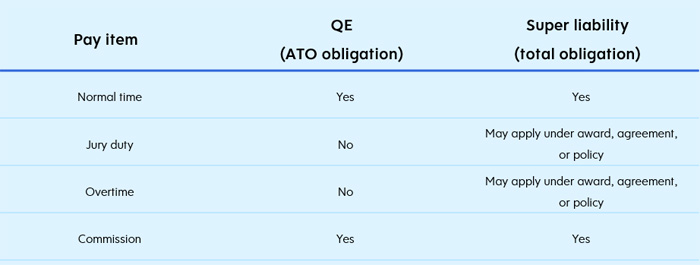 These examples are illustrative only. Employer obligations may vary depending on applicable awards, enterprise agreements, contracts, and organisational policies.
That distinction means payroll teams now need to review pay items in much greater detail than many organisations have previously required.
“You're going to need to go through and say, does the ATO require me to pay super on this?” Low explained. “And in your payroll systems, you're likely to have hundreds of pay items requiring that assessment.”
Moore acknowledged that many employers may not have QE reporting fully mature from day one. STP lodgements missing QE will not initially be rejected, but employers are expected to transition during the first year and ultimately provide a full year-to-date QE figure.
The data issues Payday Super will expose earlier
Under today’s system, rejected super contributions are often manageable. Funds typically have about a month to resolve data issues before allocating contributions, and Moore says approximately 99.5% of contributions are successfully processed. Under Payday Super, funds may only have three business days, which significantly changes the operational impact of payroll data quality. Issues that can often be resolved easily today may instead become returned contributions requiring rework and manual intervention much more frequently.
The ATO estimates rejection rates could rise to 6–7% without improvements across employer data quality and verification processes, potentially resulting in 25–30 million rejected contributions in the first year.
“Look at what's happening today in your systems, in any messaging getting back from funds that are indicating something's wrong,” Moore advised. “Fix that now, because that could become an error under Payday Super.”
How the ATO will reinforce expectations
One of the clearest messages from the session was that the ATO’s focus will not be on organisations that make genuine efforts and quickly correct issues. “We will always direct our attention to those that aren't paying, as opposed to those who are generally trying to do the right thing and might be a little bit late,” said Moore.
The bigger change is how quickly issues may now become visible. “There is no such thing as a random audit anymore,” Low said. “The ATO have so much data now, they share it amongst themselves, and it's constantly being analysed.”
With QE reported through every STP submission, inconsistencies between earnings and super obligations may become much easier for the ATO to identify earlier. Importantly, both Moore and Low repeatedly reinforced that mistakes will happen during transition. The expectation is that organisations act quickly when issues are identified.
What payroll teams should prioritise
The payroll teams making the strongest progress are now focusing on a handful of practical priorities.
Start paying on payday
"Absolutely pay on payday,” shared Low. “That sends a good sign to the ATO that you're doing the right thing." For organisations still refining QE setup and reporting classifications, payment timing remains one of the clearest indicators of genuine effort.
Map the full contribution journey
Understanding the end-to-end timing of contributions is becoming increasingly important. When does payroll run? How long does the clearing house take? When does the fund allocate the payment?
“Understand how your processes work today and how long things take,” Moore advised. The final legislation shifts from seven calendar days to seven business days, giving employers slightly more operational flexibility. But that timeframe still includes clearing house processing and fund allocation timing.
Resolve data issues before go-live
Outdated member details and invalid choice forms that can often be corrected quietly today may become immediate rejection events under a three-day allocation window.
This is why many organisations are using the transition period to review data quality and contribution processes before the go-live pressure increases further.
Plan for exceptions
Errors will happen during the first year. The organisations most likely to respond effectively are those that already understand how exception management, corrections, voluntary disclosures, and remediation processes will operate internally before problems occur.
Payroll operations is becoming increasingly real-time
Payday Super reflects a broader shift already underway across payroll operations, including wage theft legislation, real-time STP reporting, and increasingly sophisticated data matching between agencies.
Together, those changes are creating a more continuous reporting environment where issues become visible much earlier. “It is a complex reform, and it's probably an ambitious reform in relation to the timeframe to deliver,” acknowledged Moore. That pressure is being felt across the entire ecosystem, with employers, payroll providers, clearing houses, super funds, and the ATO all implementing major operational changes simultaneously.
For payroll leaders, the message is that stronger payroll data, better process visibility, and earlier preparation will help you prepare for the changes ahead.
Can your payroll platform support Payday Super requirements?
Dayforce can help your organisation review payroll processes, identify potential data quality risks, assess QE reporting readiness, and prepare for operational changes. Take our one-minute quiz to identify any potential gaps in your organisation.
Start your free Payday Super readiness assessment
More Payday Super resources:
Ready to get started?