How Dayforce AI governance accelerated innovation
Most organisations see AI governance as a barrier to innovation. Dayforce showed otherwise. Discover the three-phase framework that helped us scale from 16 to 121 AI initiatives in one year while supporting compliance across global jurisdictions.

Table of Contents
At 2,100 degrees Fahrenheit, molten glass is both beautiful and dangerous. In the hands of a skilled glassblower, raw glass transforms into something valuable — a delicate ornament, a functional vessel, a work of art. But this transformation doesn't happen by chance. It follows a precise, repeatable process where every step matters, safety is paramount, and each movement builds on the last.
Working with AI in HR isn't much different. At Dayforce, we've learnt that turning raw workforce data into responsible AI features requires the same thoughtful approach. Over the past two years, we've built an AI governance framework that isn’t designed to just check boxes — it is intended to enable innovation while protecting what matters most: trust.
The regulatory imperative
The AI regulatory landscape is evolving fast. Countries, states, localities, and government agencies are rapidly introducing legislation, regulations, and other guidance addressing AI.
When you're handling compensation data, performance reviews, and personal demographics, the stakes are too high for shortcuts. A biased algorithm can impact real careers and real lives. But governance isn't just about avoiding fines — it's about building systems people can trust.
Our foundation: Principles before process
Every strong governance framework needs a north star. Our AI Ethics Principles are built on two pillars: Trust (privacy, transparency, reliability, sustainability) and Employee Focus (social good, inclusion, accountability).
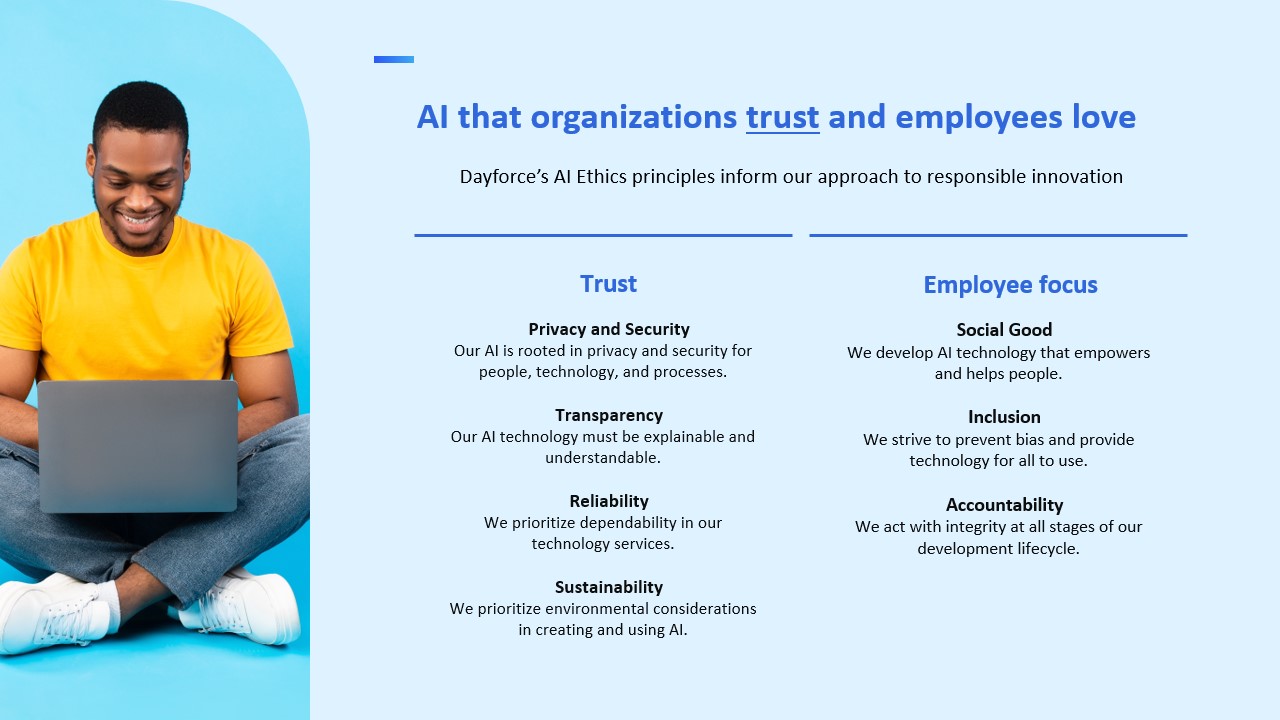 These principles are designed to help guide decisions — from initial concept to deployment and beyond. We review them regularly to help ensure they reflect evolving ethical standards.
Three phases: From idea to impact
Our process spans three phases. Each phase is designed to keep innovation moving safely from concept to production: Review, Development, and Monitoring.
Phase 1: The critical first gate
Before a single line of code is written, we ask the hard questions:
- Is AI even necessary?
- Do we have quality data?
- Are there privacy or regulatory concerns?
Our Chief Privacy Officer, Chief AI Officer, and governance team evaluate AI ideas. This early intervention is designed to help prevent costly pivots and allow us to approach problems thoughtfully.
Phase 2: Governance embedded in development
We don't treat governance as a final checkpoint — it's woven into our development phases. Our teams are diverse in their expertise, including data science, product, engineering, and ethics.
Before launch, AI features must pass a comprehensive rubric covering 50 questions across data quality, bias risks, model performance, legal compliance support, and team diversity.
Phase 3: Vigilance after launch
Deployment isn't the finish line. We continuously monitor for performance drift, bias, adverse impact, and regulatory changes.
For high-risk models, especially those used in hiring, we conduct annual third-party bias and fairness audits and maintain human-in-the-loop requirements. Our goal is to avoid fully automated employment decisions.
The results: Innovation through governance
Here's the surprising part: strong governance can help accelerate innovation.
Last year: 16 AI ideas reviewed
This year: 121 AI ideas reviewed
That's 656% growth*—and we attribute this growth in part to the trust and clarity our framework helps provide.
*Dayforce internal data, 2025
When teams know the guardrails, they often move faster and make smarter decisions. We've also launched an AI Ethics Council — five independent professionals from academia, industry, and civil society who meet quarterly to help us challenge our thinking and identify blind spots before they become problems.
Your roadmap: Three practical tips
Tip 1: Start with principles
Define your ethical foundation first. Clarity at this step will help guide every decision downstream.
Tip 2: Build a risk programme
Create an AI inventory, conduct risk assessments, and ask vendors the right questions.
Tip 3: Be scrappy
Don’t wait for perfect tools. We started with Excel, Jira, and SharePoint — adapting existing privacy assessments for AI. As your programme matures, specialised platforms can help you scale.
The bottom line
Like glassblowing, working with AI requires skill, respect for the material, and commitment to safety. The more you practise the process, the faster and more confident you become.
At Dayforce, we’ve seen that strong governance can help teams ship faster, help customers gain confidence, support better privacy practices, and innovation can flourish within ethical boundaries.
Because at the end of the day, AI in HR is about the people those algorithms serve. Organisations that invest in AI governance frameworks today can be the ones that successfully scale AI tomorrow, building trust while driving measurable outcomes.
You may also like:
Ready to get started?